
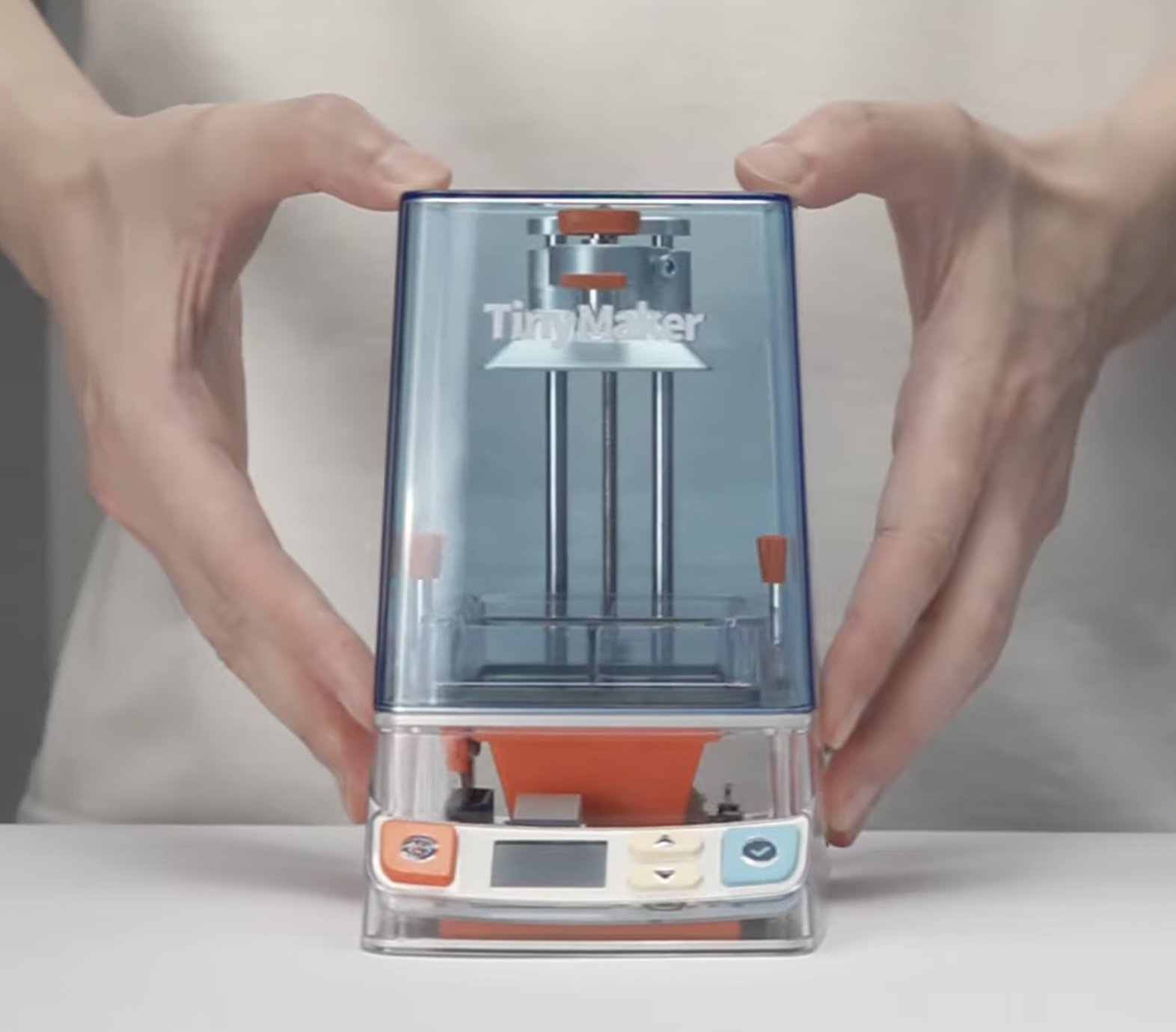
So here we go! A friend today said “Kat, you may have a problem.” Okay, so I bought my sixth 3D printer a week or so ago, because I found a really cute resin printer on Indiegogo called the TinyMaker that was too cool to pass up. I mean, doesn’t everyone take a 3D printer on vacation? So this is resin printer number three, and I’m on filament printer number three as well. What’s the difference?
filament printers
If you’re a glass artist or make pottery, this is what I recommend. Filament looks like a roll of plastic Weedeater twine…it’s pretty inexpensive, it’s easy to print.
There are many different types of filament:
PLA (basic, matte, silk, transparent, glow in the dark, glitter)
ABS (heat resistant)
PETG (food safe)
Wood (stainable!)
Carbon fiber (strong, reinforced)
Castable filaments (burns out in a kiln)
TPU (flexible, like those “jelly” shoes from the 1980s)
And there are MANY more out there. There are also companies like TimePlast that make soap filaments so you could print your own custom soaps, or even “fish bait.” Check out their page. Bizarre.
The easiest to print is PLA, and I’d recommend basic or matte as a place to start.
resin printers
Now, I don’t recommend resin printers for glass artists, but I use these for creating smooth, high-resolution models for casting jewelry. The print beds are usually fairly small when compared to filament printers, so we’ll stick to filament printers for now. My current resin printer is an Elegoo Saturn 4 Ultra. I can use castable resin for lost wax casting of jewelry, or print cheaper resins and make silicone molds for wax injection.
I love my first resin printer, a Formlabs Form 2 printer, but unfortunately their new business model involves charging customers who need to use other specialty resins. The Form 4 printer is $3,499 last time I checked, but then they charge $875 for a “license” to use other castable resins. So I bought the Elegoo.
what brand of printer do I recommend?
Bambu H2D with HT (high temp) and AMS 2 (color changer) units
There are many, many companies making 3D printers, so there are a lot to choose from. My first was an Ender 3 Pro, a printer from Creality which was maybe a little over $250. My second was a printer I backed on Kickstarter, the AnkerMake…made by the same company that makes power banks that you find on Amazon, maybe $599? I’ve also used another rock-solid printer called a Prusa MK4, which is what you’ll find at Pilchuck Glass School and Pittsburgh Glass Center.
But my third printer—the one I use now—is a Bambu H2D. And as much as I LOVE this printer, it’s overkill for what most of you might be doing, with bit of a higher price. Why did I choose it? I’m glad you asked…
features
Here’s what I was looking for after working with other printers:
Wireless printing was a MUST. I got tired of running back and forth with a MicroSD card to transfer files. Also, printers with Wifi allow the user to monitor printing progress via streaming video.
Auto-leveling bed. “Leveling” is actually a calibration that ensures the nozzle is a consistent height above the bed. The Ender required that I use a piece of paper and some knobs to perform this adjustment each time I printed. Never again! 😕
An enclosure. I had difficulties printing higher temperature filaments like ABS with my AnkerMake, so an enclosure helps maintain temperature. It’s also very helpful if you’re in a high-humidity environment, because a lot of filaments are “hygroscopic,” which means moisture in the air can cause printing problems. You can add third-party enclosures to other printers, but I wanted one that was incorporated with a heated chamber.
Larger print area. The H2D has a larger print area—about 13”x13”x13”. That’s actually the reason I chose the H2D. The other Bambu printers have a build area that’s about 10”x10”x10”, which is still a really nice size.
Color changer. I used to think printing color was a gimmick, but when I bought the H2D I added it on a whim. I have since changed my mind on this, and printing with color is a blast! See the cool Cactus Chess Set from the subscription site ForgeCore below. There were a couple other reasons to have this…the color changer is also a great place to store your most frequently used filaments in a humidity-controlled environment, and there are also special filaments that can be used to support the model while printing that are water soluble. More about that later.
my recommendation for glass folks
So that brings me to my recommendation for my glass friends. And I will preface this section by saying that I am not compensated in any way by Bambu for my recommendations. No affiliate links, nada. I’m just really impressed with my latest purchase.
I would not hesitate to purchase a printer from other mainstream companies like Prusa. I just think that Bambu has done a really awesome job of making a printer that’s easy to use.
Probably a good place to start is budget. I would say if you can swing $600 for a printer, I would take a look at the Bambu P2S, which as of this writing is $549 on Bambu’s site. They have free shipping, and usually when you buy, they will have a discount available on their filaments (40% right now!). If you can swing $749, you can get the P2S with the “AMS 2” color changer unit. This printer is a little faster than my second recommendation, and has a really nice color touchscreen that makes it super easy to use.
My second recommendation would also be a Bambu printer. The Bambu P1S printer alone right now is $369. It has a more basic screen, but is a solid printer. There are two different “AMS” units, which are the color changer units; the AMS 2 actively heats the filaments and maintains low humidity, so I would recommend spending a little bit more for the AMS 2 version. With that extra feature, the price is $539 as of August 2026.
My thinking is that for most people, the color changer is not critical, and it can be added to either printer in the future, so there is an upgrade path.
Bambu P1S (no AMS): good if you’re on a tight budget
Bambu P1S (with AMS 2): if color is a must, but you’re on a budget
Bambu P2S (no AMS): my best recommendation if color isn’t necessary
Bambu P2S (with AMS 2): if you have more flexibility on price
Bambu H2D (with AMS 2): if you need a larger print area, and also has an optional laser add-on
There are also two other H2 models…the H2C and the H2S. The H2S is a “single nozzle” version of my printer that makes it a bit more affordable, and the H2C has induction heating for faster color nozzle changes with less waste. Both of those have the larger build volume, but I think they’re overkill for what most glass artists might need. The details on the three printers are here.
Feel free to comment below if you have questions…I’m more than happy to share!